



Trade With Data – Minus Emotions
By Q | Coffee With Q
Every day, the same thing happens.
Price moves. Retail traders react. They chase. They buy the dip. And then the market reverses—right after they enter.
- It’s not bad luck.
- It’s not random.
- It’s by design.
What most traders don’t realize is that their losing trades are someone else’s winning entry because trading is a ZERO SUM GAME.
The question is: which side do you want to be on?
The Game You Didn’t Know You Were Playing
Here’s the reality of modern markets: smart money needs liquidity to execute large positions. They can’t just buy or sell whenever they want—they need someone on the other side of the trade.
That someone is usually retail. (YOU!)
Smart money doesn’t chase breakouts. They create them. They push price to levels where retail traders will react predictably, then they use that reaction as their entry.
- It’s not manipulation—it’s market mechanics.
- And once you understand it, you’ll never look at a chart the same way.
Market Structure: The Language of Price
Before indicators. Before algorithms. Before any of the tools we use today—there was market structure.
What is Market Structure?
Market structure is simply the pattern of:
- Higher highs
- Higher lows
- Lower highs
- Lower lows
…that price creates as it moves.
What It Tells You:
- Who’s in control
- When control shifts
- When someone is trying to fake you out
The Problem
Most traders don’t know how to read it properly.
They see price move up and they call it an uptrend. They see price move down and they call it a downtrend. But that’s surface level.
The real question is: is that move valid, or is it a trap?
Valid Structure vs. Inducement
This is where my approach differs from everything else you’ve seen.
I’ve developed a methodology that distinguishes between valid structure and inducement in real-time:
- When structure is valid → I trade with it
- When it’s inducement → I stay out or position for the reversal
My Signal System:
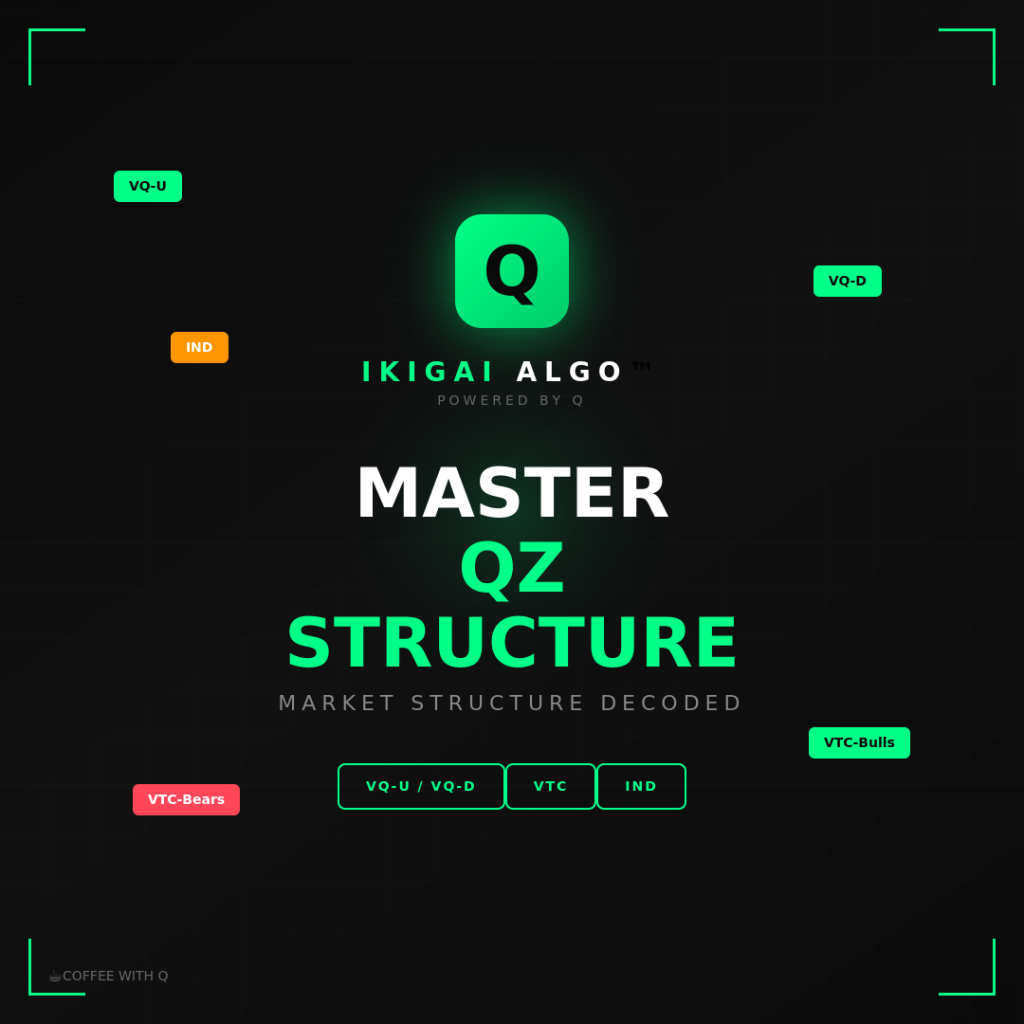
| Signal | Meaning |
| VQ-U | Valid structure move UP |
| VQ-D | Valid structure move DOWN |
| IND | Inducement — smart money hunting liquidity |
| VTC-Bulls | Valid Trend Change — bulls took control |
| VTC-Bears | Valid Trend Change — bears took control |
These aren’t random labels. They’re based on specific price action criteria I’ve developed over years of studying how smart money operates.
The methodology is:
- Precise
- Repeatable
- Works across any timeframe
What This Looks Like in Practice
Imagine it’s market open. Price pushes hard in one direction. Retail traders see momentum and pile in.
I’m watching for something different.
I’m waiting to see if that move is VQ or IND:
- If it’s valid structure → I’m looking for my entry with the trend
- If it’s inducement → I know those traders who just entered are about to become exit liquidity
The difference between a winning trade and a losing trade often comes down to this single distinction.
While most traders are reacting to what price did, I’m reading what price is telling me about what happens next.
Multi-Timeframe Precision
Here’s how I execute:
Higher Timeframe = BIAS
- Is the structure bullish or bearish?
- Who’s in control?
- Is the trend intact or has it changed?
Lower Timeframe = PRECISION ENTRY
- Each trade becomes a 15-30 second execution
- No sitting in trades hoping they work
- No wide stops getting hunted
- Clean entries, tight risk, clear targets
The higher timeframe tells me WHAT to do.
The lower timeframe tells me WHEN to do it.
Why Most Traders Get This Wrong
Most traders are playing checkers while smart money plays chess.
What Retail Does:
- Looking at lagging indicators that tell them what already happened
- Drawing support and resistance lines that everyone else sees
- Using the same strategies retail has used for decades
The Problem:
Smart money has learned to exploit all of it.
Market Structure is Different:
- It’s not a lagging indicator
- It’s not something you overlay on a chart
- It’s the chart itself
- It’s understanding what price is actually doing, in real-time, without the noise
But reading structure correctly takes:
- Training
- Practice
- Someone who’s done the work to show you what to look for
The IKIGAI Algo: Structure in Real-Time (Objectivity)
I’ve coded my market structure methodology into the IKIGAI Master QZ Structure indicator.
What It Does:
Marks in real-time as price develops:
- ✅ VQ-U
- ✅ VQ-D
- ✅ IND
- ✅ VTC-Bulls
- ✅ VTC-Bears
No guessing. No subjectivity. The algo does the work so you can focus on execution.
What Makes This Different:
Here’s what separates this from every other indicator out there: you’ll understand what it’s showing you.
When you learn the methodology behind the signals:
- You’re not dependent on the technology
- If your tech stack breaks, you can still trade
- If the internet goes down, you can still read a chart
The algo is a tool that enhances your edge—it’s not a crutch that replaces your thinking.
Learn the Methodology
I teach all of this in my masterclass.
What You’ll Learn:
- Not just what the signals mean—but why they work
- How smart money operates
- How to read structure across multiple timeframes
- How to identify inducement before you get trapped by it
- How to execute with precision in a 15-30 second window
If you want to learn the art and data science of price action—without complex charts cluttering your screen—and trade Zero DTE options like a sniper…
This is where you learn.
I don’t give you fish. I teach you to fish. So you can eat for a lifetime.
Two Ways to Level Up
1. Get the Algo
The IKIGAI Master QZ Structure indicator marks everything in real-time:
- VQ-U, VQ-D, IND, VTC-Bulls, VTC-Bears
- All plotted automatically as price develops
- You’ll see exactly what I see
2. Take the Masterclass
- Learn the complete methodology behind the signals
- Understand market structure at a level most traders never reach
- Know why the algo marks what it marks
- Never be dependent on technology alone
The traders who do both?
They’re the ones who stop being liquidity and start collecting it.
Coffee With Q. Where we decode the market together.
— Q
This is not investment advisory. I’m not calling trades. I’m teaching you to think.
Disclaimer
Trading futures and options involves substantial risk of loss and is not suitable for all investors. Past performance is not indicative of future results. The IKIGAI Algo and any associated indicators, tools, or educational materials are provided for informational and educational purposes only and do not constitute financial, investment, or trading advice. You should consult with a qualified financial advisor before making any trading decisions. Q Levels and affiliated parties are not registered investment advisors, broker-dealers, or financial planners. By participating in this program, you acknowledge that you are solely responsible for your own trading decisions and any resulting gains or losses. No guarantees of profit or specific results are made or implied. All sales are final. Please trade responsibly and only risk capital you can afford to lose.