

By Qamar Zaman
Every pullback is an absorption until structure breaks. Learn to see the difference and you stop fading trends before they finish.
This guide shows you how to read a pullback with the Seafire DCB Dominance labels. You will learn what absorption looks like, where it fails, and why the close of one candle decides the whole trade. The method works the same on Seafire15 and Seafire1.
Who this is for
You trade fast. You scalp futures or work 0DTE options. You run Seafire and you read structure. You keep getting shaken out of good trends by pullbacks, then watch the trend continue without you.
If you swing trade over days, this is not your tool. The DCB labels and this pullback method are built for fast execution, where the next candle arrives in seconds.
What absorption means
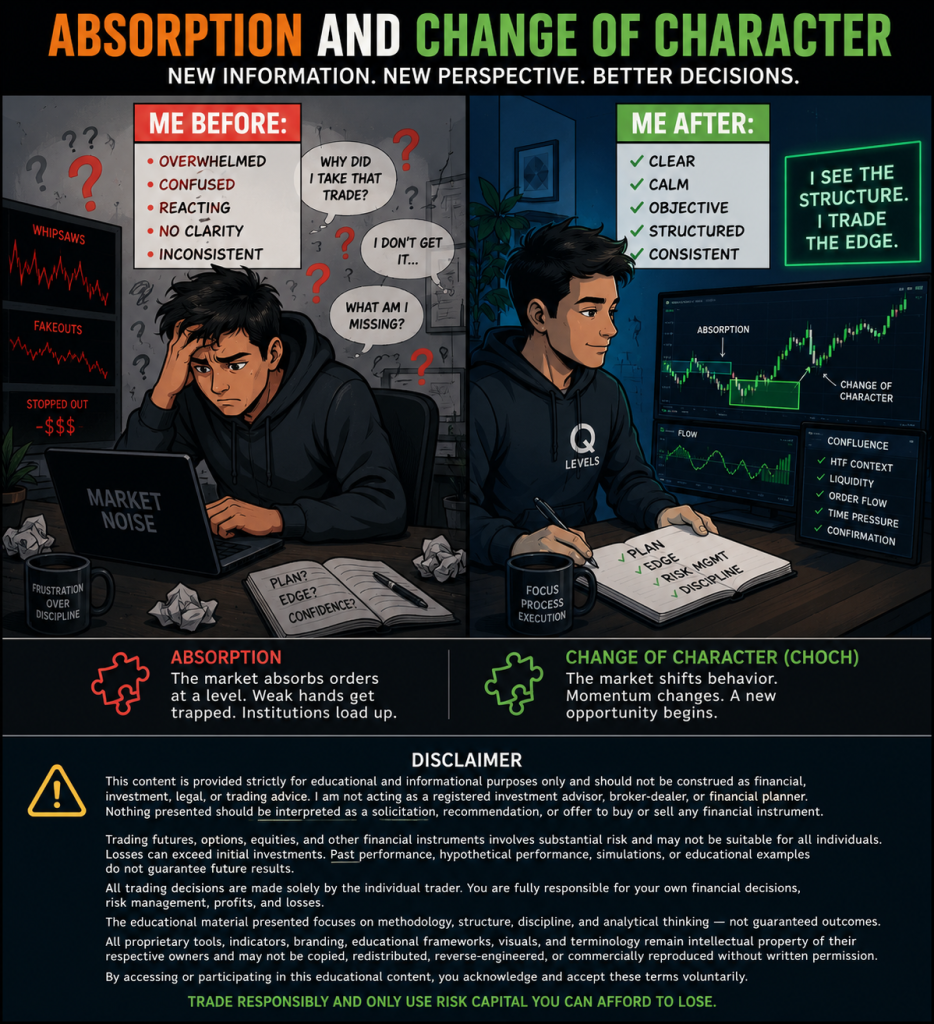
A trend moves in one direction. Then a counter-trend candle shows up. In an uptrend, a seller candle appears. In a downtrend, a buyer candle appears. The trend side meets the pressure and absorbs the push. Price gives the counter-move back. The trend continues.
This is absorption. The counter-trend side spent effort and got no result. Every healthy pullback works this way. Sellers push into an uptrend, buyers absorb them, price resumes higher.
The trap: every pullback looks the same at the start
Here is the problem. A seller candle in an uptrend looks identical whether buyers will absorb the push or the trend turns. One candle does not tell you which.
The DCB Dominance labels show you who won each bar inside the pullback. A run of S labels during a dip tells you sellers are taking the bars. Useful, but the labels do not call the trend for you. They read the candle, not the structure.
So you need a second layer. Structure.
The line you protect
In an uptrend, price builds higher highs and higher lows. The most recent higher low is your line. In a downtrend, price builds lower highs and lower lows, and the most recent lower high is your line.
Hold the line and the pullback is absorption. The trend side is still in control. Lose the line and the read changes.
The close is the line, not the wick
Here is the part to get right. A wick is not a break. A close is.
Price wicks below your higher low and closes back above it. This is a sweep. Sellers reached down for liquidity, buyers absorbed them, price reclaimed the line. Absorption worked. A sweep is often the strongest continuation entry you will get, because the weak hands got flushed first.
Price closes below your higher low. This is Change of Character. Absorption failed. The higher low structure is broken. You are no longer in a pullback. You are in a possible reversal, and the trend side lost control.
Same level. Two outcomes. The close decides.
How the DCB labels fit inside this
Run the structure read first. Mark your higher low or lower high. Then watch the pullback candles at the line.
The DCB labels confirm what you are seeing. Sellers absorbed at the line, then a B label prints as buyers retake the bar. The label agrees with the structure. Now you have two things pointing the same way.
If the labels and the structure disagree, you wait. A B label means nothing once price has closed below your line. Structure outranks the label every time.
Why this stays a read, not a button
You might want the indicator to mark absorption for you. We built the tool the other way on purpose.
Every pullback is absorption until the moment absorption fails. An indicator marking every pullback would mark every pullback. The result is noise, not signal. The value is not in spotting the absorption. The value is in spotting the exact line where absorption fails, and the line is a structural judgment.
One indicator is never a buy or a sell. The DCB labels give you the conviction read. You supply the structure. The trade lives where the two meet.
How to practice it
Open replay on a trending session. Mark every higher low as price builds the trend. Watch what happens when price pulls back into each one. Note which lines hold with a wick and reclaim, and which lines break on a close.
Do this for fifty pullbacks before you size up. You will start to feel the difference between a sweep and a Change of Character before the candle closes. The feel is the edge. The labels confirm it. Structure earns it.
A pullback is not a reason to exit. A close through your line is. Learn to tell them apart and you stop handing back your best trends.
DISCLAIMER
This content is provided strictly for educational and informational purposes only and should not be construed as financial, investment, legal, or trading advice.
The concepts, tools, indicators, models, market commentary, and educational materials discussed — including Seafire, DCB Engine, IKIGAI Algo, Q Levels, FLOW, Time Pressure, and related proprietary systems — are designed to teach market structure, decision-making frameworks, and trading psychology. They are not intended to provide specific trade recommendations or investment advice.
I am not acting as a registered investment advisor, broker-dealer, or financial planner. Nothing presented should be interpreted as a solicitation, recommendation, or offer to buy or sell any financial instrument.
Trading futures, options, equities, and other financial instruments involves substantial risk and may not be suitable for all individuals. Losses can exceed initial investments. Past performance, hypothetical performance, simulations, or educational examples do not guarantee future results.
All trading decisions are made solely by the individual trader. You are fully responsible for your own financial decisions, risk management, profits, and losses.
The educational material presented focuses on methodology, structure, discipline, and analytical thinking — not guaranteed outcomes.
All proprietary tools, indicators, branding, educational frameworks, visuals, and terminology remain intellectual property of their respective owners and may not be copied, redistributed, reverse-engineered, or commercially reproduced without written permission.
By accessing or participating in this educational content, you acknowledge and accept these terms voluntarily.
Trade responsibly and only use risk capital you can afford to lose.